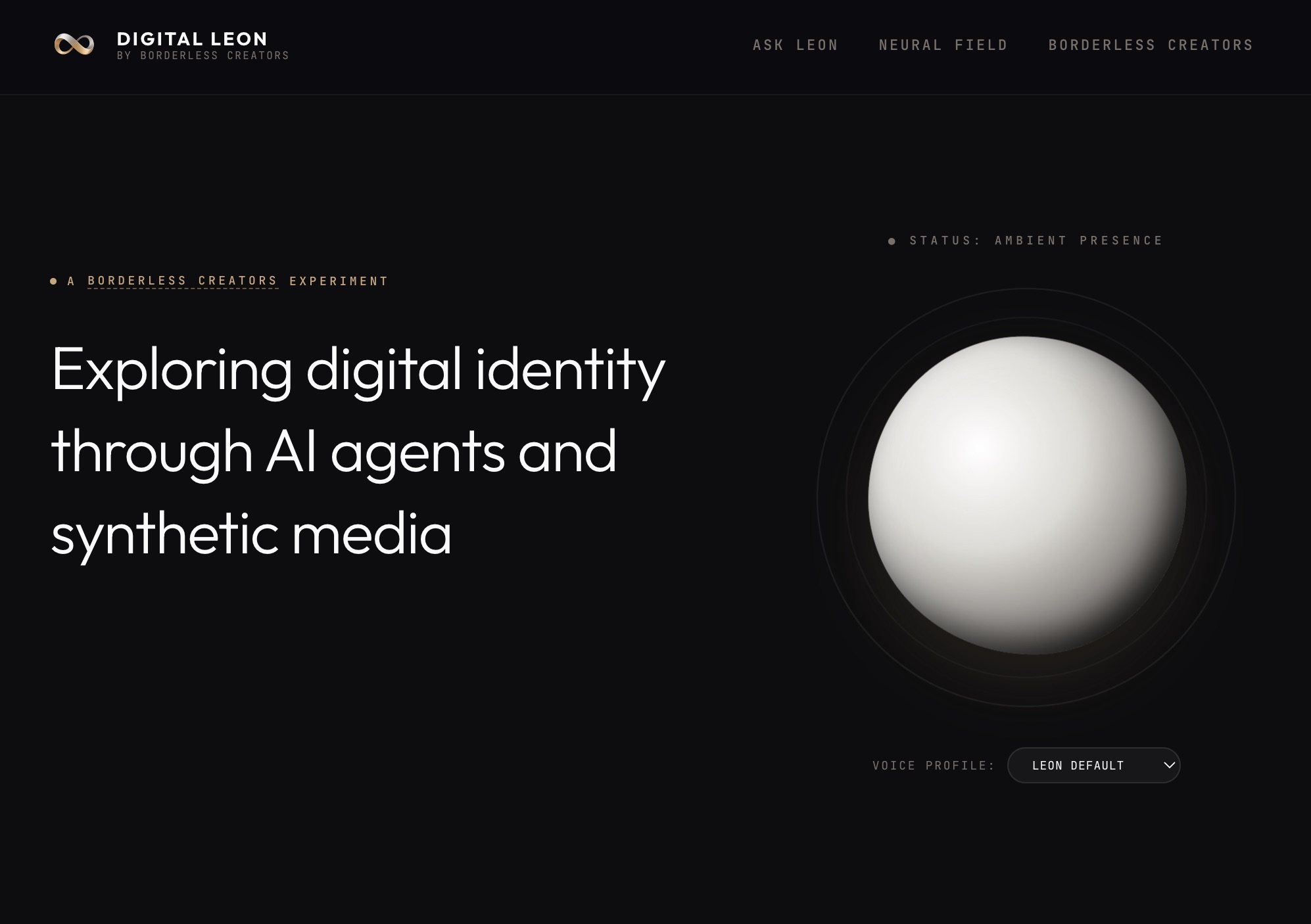
I’ve started to think the next major interface won’t be a screen at all. It might be you.
Every AI experiment begins as a technical question. But the more interesting ones eventually become human questions.
That has been my experience over the past few weeks.
After writing about AI’s shift from productivity to agency, I started testing the idea through Borderless Creators, a small personal AI lab, and Neural Field, an experiment in modular intelligence.
At first, I was focused on better ways to organize signals, context, and decisions.
But the work quickly pointed deeper inside.
Agency needs intelligence.
Intelligence needs context.
And context needs an interface.
The more personal and contextual AI becomes, the less likely it is to remain just a dashboard, feed, search box, or chatbot.
Increasingly, I believe the next interface may be digital identity.
From Intelligence to Identity
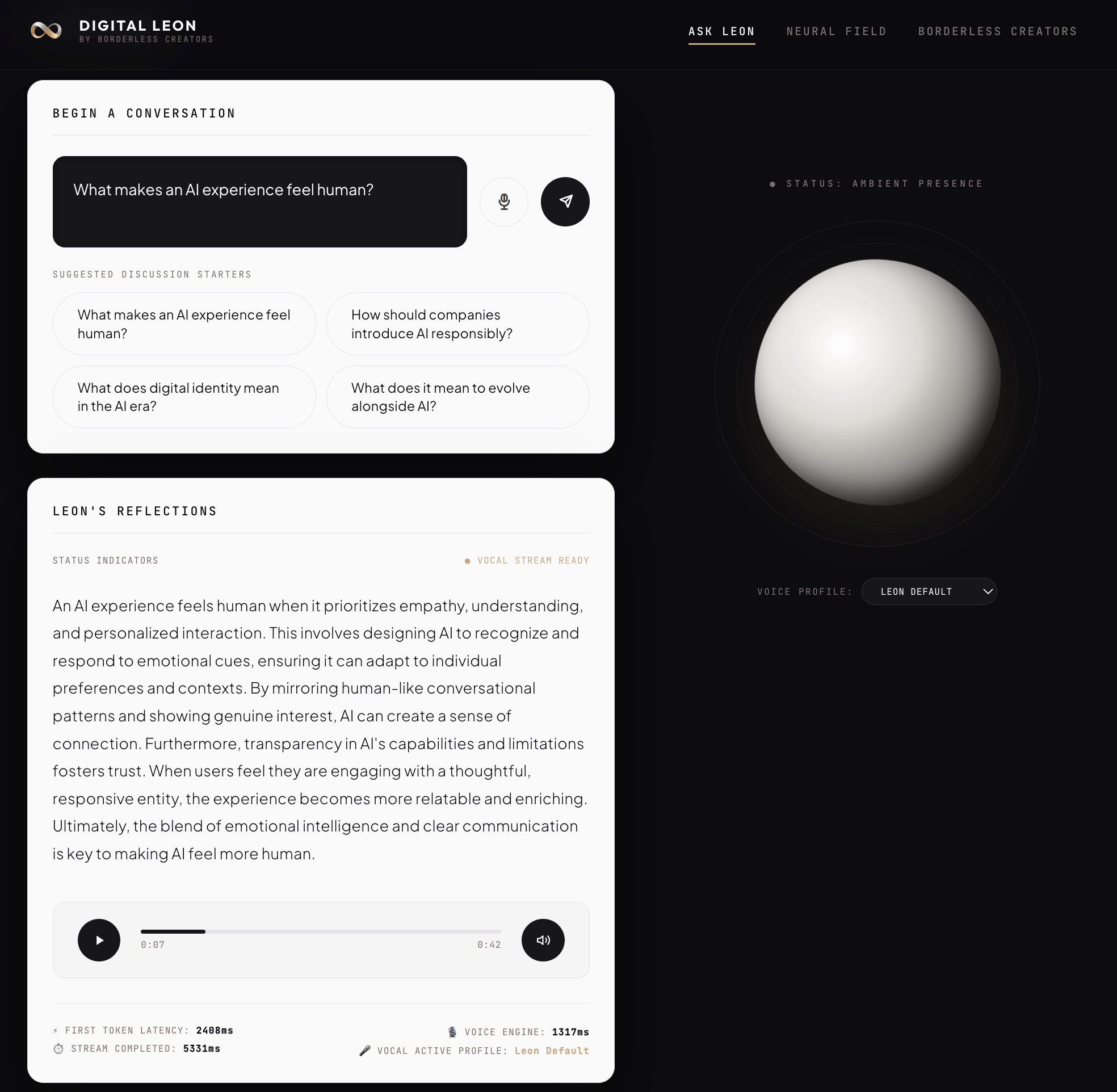
This is where Digital Leon comes in.
ask.leonchen.ai
Digital Leon
An early experiment in digital identity — a voice-driven version of my own context, memory, and perspective.
Today, Digital Leon is still early — closer to a voice identity than a fully realized digital self. But even in this simple form, it raises a much larger question:
What does it mean for a person’s voice, context, memory, and perspective to become digitally accessible?
That question is emotional. It is even more ethically difficult.
Digital humans matter because they may change how people interact with other people, organizations, brands, communities, and AI agents.
In the future, we may not only visit websites, read profiles, or open apps.
We may interact with digital representatives of people, teams, companies, athletes, artists, educators, executives, and experts.
A digital identity may answer questions, explain context, preserve memory, represent a point of view, or interact with other AI agents on our behalf.
If AI agents become part of everyday work and life, identity becomes the trust layer. It tells us who or what an agent represents, what context it carries, what authority it has, and what boundaries it should respect.
The Identity Economy
This feels especially urgent in sports, entertainment, and the creator industry.
Athletes, celebrities, and creators already live inside an identity economy. Their performances become highlights. Their faces become campaigns. Their voices become assets. Their stories become brands.
AI will make this tension more visible.
Digital identities could unlock new forms of fan engagement, storytelling, education, access, and cultural preservation.
They could also reduce people into endlessly available interfaces. Here is the uncomfortable question:
When we create a digital version of a person, are we extending their agency, preserving their legacy, or simply making them easier to consume?
Moral Authorship
This is why I keep coming back to moral authorship.
Building with AI is no longer only about generating outputs. It is about taking responsibility for the identities, memories, relationships, and meanings we help machines carry forward.
A digital human is not just a user experience. It may become a representation of someone’s presence.
An AI agent is not just an automation layer. It may act on someone’s behalf.
So the defining question is not simply:
Can we build it?
The harder question is:
What kind of human reality are we authoring?
If we want only efficiency, AI will optimize us into systems.
If we want only scale, AI will amplify consumption.
If we want only simulation, AI will blur the boundary between presence and performance.
But if we want dignity, agency, memory, creativity, and human flourishing, then we have to build toward those values deliberately.
As AI starts to represent people, organizations, creators, athletes, and eventually our own agents, how do we design digital identity with both imagination and responsibility?
I would love to hear your thoughts on this, especially those working at the intersection of AI, product, entertainment, sports, identity, and trust.